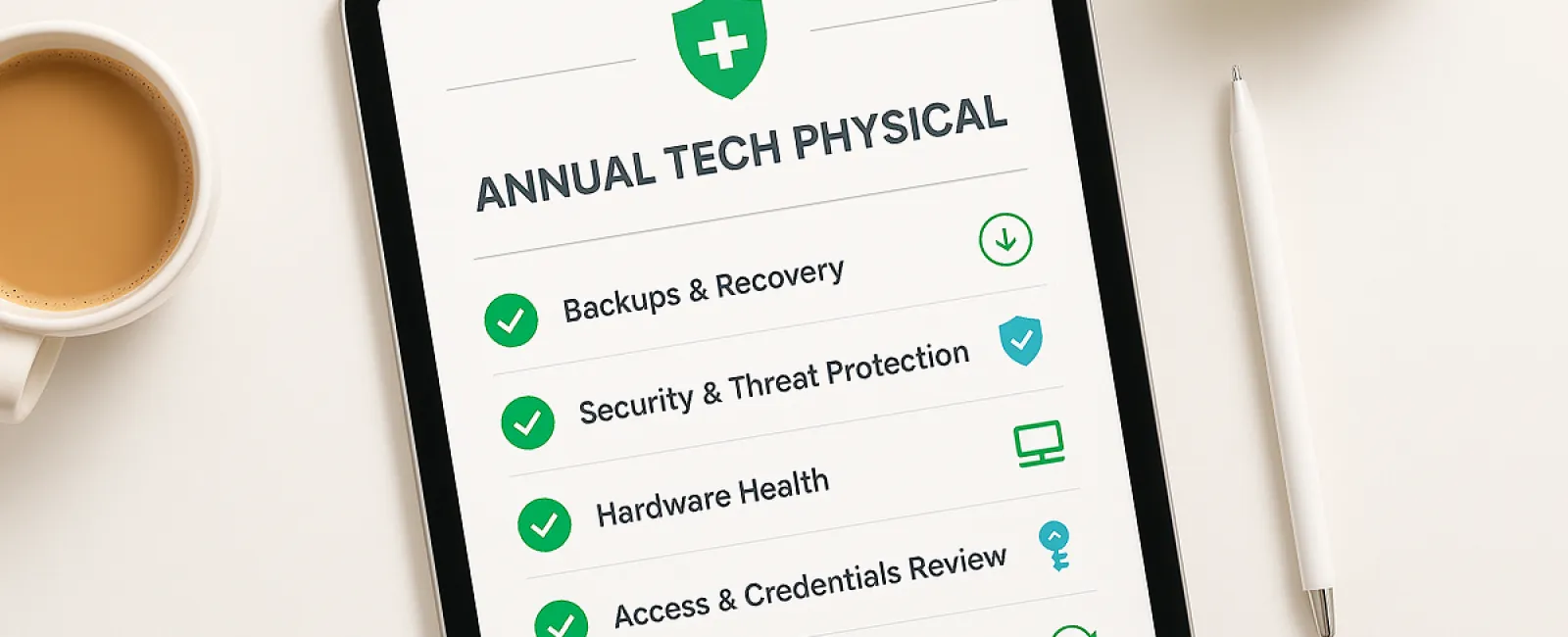
January is the month people finally schedule the appointments they've been putting off. The doctor, the dentist, the mechanic,we all prioritize preventive care because we know that while it's boring, it is significantly cheaper than a preventable disaster.
But for Higher Education leaders, there is an uncomfortable question to ask: When is the last time your department's technology got a real checkup?
In a university setting, "working" and "healthy" are two very different things. A research server can be "working" today while sitting on a critical vulnerability that makes a data breach inevitable tomorrow.
The Danger of "Normalizing" Risk
Most academic departments skip tech checkups because nothing hurts. "The portal is up," "The Wi-Fi is fine," and "We're too busy with the new semester." But the risks that dismantle institutional reputations are almost always invisible until they become an emergency:
- Undetected Compliance Gaps: Assuming you meet GLBA or FERPA standards without an audit is like assuming your blood pressure is fine without a cuff.
- Access Creep: Research assistants and adjuncts who left three semesters ago still have active credentials.
- The "Paper" Backup: Backups that exist on a schedule but have never been tested for a full system restore.
- Aging Infrastructure: Hardware that is "fine" until the day it fails, taking years of unbacked-up research data with it.
What a Higher Ed "Tech Physical" Actually Examines
A real technology assessment looks at your institution systematically, looking for the "silent killers" of productivity and security.
1. Vital Signs: Recovery Resilience
This is the heartbeat of your department. Most institutions only discover their backups are broken during a ransomware attack. That is like discovering your airbags don't work during the crash.
- The Check: Are backups completing successfully every night? When was the last time you performed a test restore to confirm the data is actually usable?
2. Heart Health: Infrastructure Lifecycle
Hardware doesn't fail politely. It ages out, security patches stop, and then it dies during finals week.
- The Check: Is your core equipment (servers, firewalls, switches) past manufacturer support? Running hardware until it "explodes" isn't a strategy; it's a liability.
3. Bloodwork: Identity & Access Management
Access creep is how breaches happen. It's not usually a "hacker" in a hoodie; it's an old account that was never deactivated.
- The Check: Can you produce a clean list of everyone with access to your sensitive student data? Are there former employees or vendors still in the system?
4. Specialist Referrals: Compliance & Research Security
In Higher Ed, "healthy" has a specific definition enforced by federal law and grant providers (NSF, NIH).
- The Check: If an auditor walked in today, could you prove your data handling meets the specific security requirements of your latest grant?
Warning Signs You're Overdue
If any of these sound familiar, your department is in the "High Risk" category:
- "I think our backups are working."
- "Our server is old, but it hasn't crashed yet."
- "We probably have some ex-staff still in the system."
- "If our IT Lead left, we'd be in a lot of trouble" (The Single Point of Failure).
The Brutal Math of Skipping the Checkup
Prevention is boring. Recovery is a crisis. A HIPAA or FERPA violation can result in fines hitting $50,000 per incident. A ransomware attack on a university now averages a recovery cost in the seven-figure range when you factor in downtime, remediation, and the devastating blow to donor and student trust.
You Can't Give Yourself a Physical
You don't check your own labs and declare them compliant; you rely on objective standards and professional oversight. Technology is no different. You need a partner who understands the unique "anatomy" of Higher Ed IT, someone who can spot the issues you've learned to work around.
Make this the January you stop guessing.
In 15 minutes, we'll outline a roadmap to move your department from "reactive firefighting" to "preventive health."
So give us a call at (303) 423-4500 or book your FREE Security Huddle instantly here: https://education.newpush.com/